

Japan Prime Minister Sanae Takaichi’s India Visit: The geopolitical landscape of the Asia-Pacific region is undergoing a massive realignment, driven by rising assertiveness from dominant regional powers and increasingly volatile global supply chains. At the center of this shifting dynamic is the partnership between India and Japan—two of Asia’s most potent economic and military democracies. From July 1 to 3, 2026, Japan’s newly elected Prime Minister, Sanae Takaichi, embarked on her maiden official visit to New Delhi for the 16th India-Japan Annual Summit. Meeting with Indian Prime Minister Narendra Modi, the historic visit signaled a major step forward in translating diplomatic goodwill into hard, actionable strategic convergence.
For decades, the relationship between New Delhi and Tokyo was defined by development assistance and cultural ties. Today, under the shadow of a rising China and global fragmentation, it has evolved into an indispensable strategic alliance. The joint statement released at the conclusion of the summit underscores a clear reality: India and Japan are no longer just trading partners; they are anchoring a mutual defence, technological, and geopolitical architecture designed to keep the Indo-Pacific free, open, and resilient against economic and military coercion.
For years, military cooperation between India and Japan was largely visible through high-profile naval exercises like “JAIMEX” or Japan’s participation in India’s International Fleet Review. However, the 2026 summit marks a fundamental shift from merely practicing together to building together.
Unified Complex Radio Antenna (UNICORN) Project
A key highlight of the talks was the agreement in principle on the technical details of the Unified Complex Radio Antenna (UNICORN) project. This advanced stealth antenna system, crucial for naval vessels to minimize radar cross-sections while maintaining communication capabilities, represents a breakthrough in bilateral defence technology transfers. Prime Minister Modi specifically welcomed Tokyo’s recent review of its strict three principles on the transfer of defence equipment and technology. This regulatory easing opens the floodgates for Japanese defence majors to collaborate directly with Indian manufacturers under the “Make in India” banner.
India-Japan 2+2 Ministerial Dialogue
The defence roadmap is also moving faster bureaucratically. Both leaders directed their ministers to convene the fourth round of the 2+2 Ministerial Meeting in Tokyo before the end of the year. This format, which brings together the foreign and defence ministers of both nations, will focus heavily on maritime domain awareness using satellite capabilities, naval maintenance, repair, and overhaul (MRO) cooperation, and expanding aerospace collaborations. To emphasize this, the summit welcomed a specialized Japanese SME mission focused entirely on the aeronautical sector, laying the groundwork for small and medium enterprises to integrate into India’s growing defence supply ecosystem.
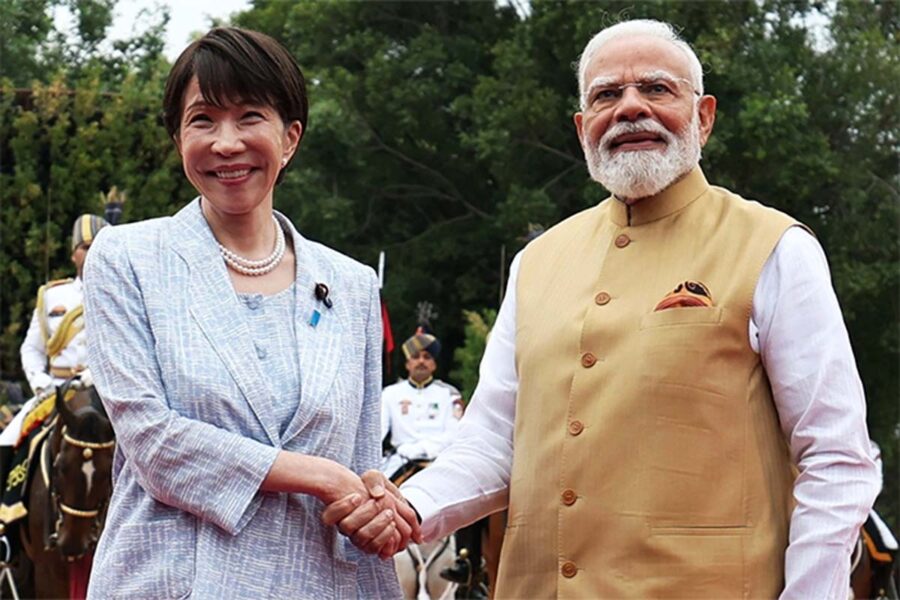
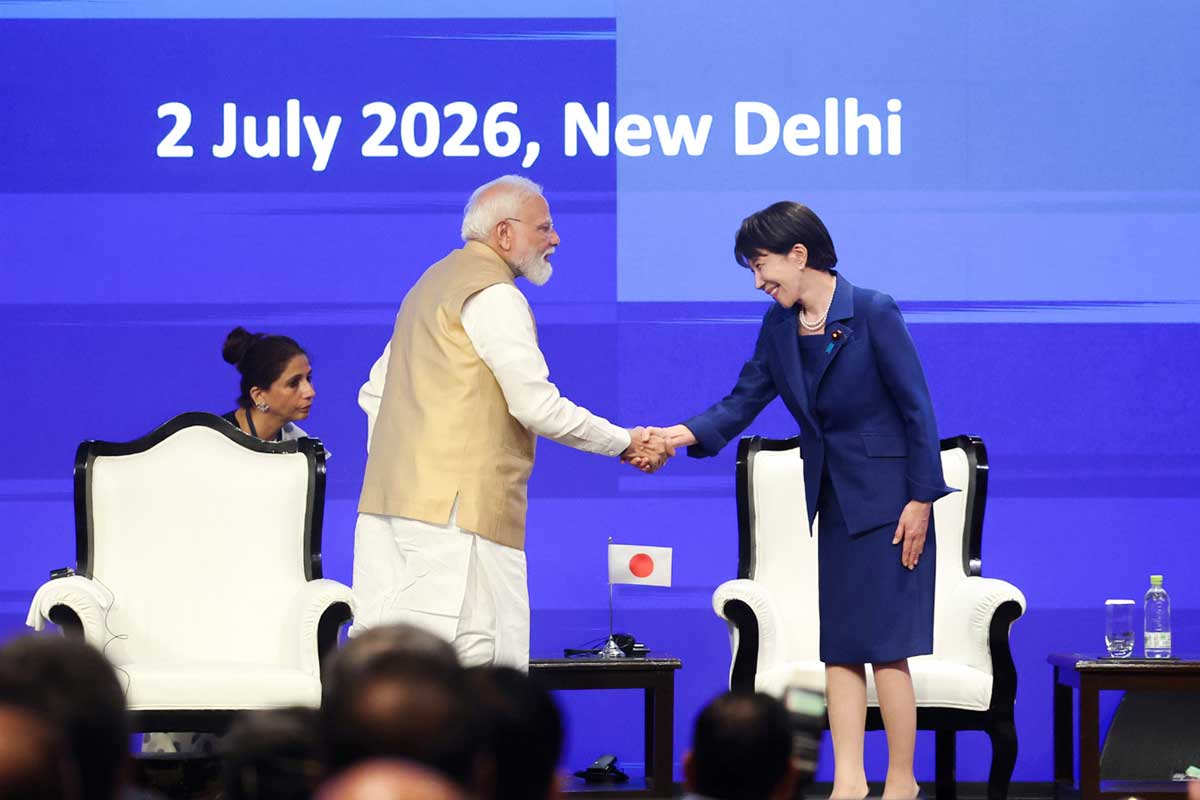
India PM Narendra Modi (R) with Japan PM Sanae Takaichi (L) in New Delhi on July 02, 2026.
India and Japan’s Focus on Economic Security
One of the most telling aspects of the Modi–Takaichi dialogue was the heavy emphasis on “economic security”—a diplomatic term that has come to signify the protection of critical supply chains from geopolitical bullying. Without naming China directly, both leaders voiced grave concerns over the use of “economic coercion” and non-market policies, such as arbitrary export restrictions and price manipulation.
In recent years, the concentration of critical mineral processing and semiconductor manufacturing in a single country has left global industries vulnerable to sudden embargoes. To counter this vulnerability, New Delhi and Tokyo adopted the landmark India-Japan Joint Declaration on Economic Security Cooperation. This framework is designed to trigger project-based collaborations in sectors that will define the next century: semiconductors, critical minerals, and information and communication technology.
READ: 100 Years of Indian Archival Data Solves Pieces of the Solar Cycle Puzzle
Resilient Supply Chain in Indo-Pacific
By easing export controls and advancing high-technology trade protections, the two nations are working to build supply chains that cannot be weaponized. Furthermore, they underscored their commitment to multilateral mechanisms like the World Bank’s Resilient and Inclusive Supply-chain Enhancement (RISE) Partnership and the Asian Development Bank’s Critical Minerals-to-Manufacturing Financing Partnership Facility. The goal is simple: ensure that the raw materials needed for everything from smartphones to electric vehicles are sourced and processed across a diversified network of trusted, democratic allies.
India-Japan AI Cooperation
As artificial intelligence and next-generation computing become the new battlefields for global influence, India and Japan are moving quickly to establish shared rules of the road. The summit witnessed the inauguration of the India-Japan AI Strategic Dialogue, resulting in a Joint Statement on AI cooperation.
Rather than focusing solely on commercial software, the leaders emphasized building a resilient, agile, and trustworthy AI supply chain. This approach aligns with the principles of the Hiroshima AI Process and the New Delhi Declaration on AI Impact, which seek to harvest the immense power of AI for sustainable growth while mitigating risks like deepfakes, cyber threats, and algorithms controlled by autocratic states.
Beyond AI, the technological partnership is reaching deep into quantum physics and outer space. The Department of Science and Technology of India and Japan’s Cabinet Office signed a Letter of Intent in Quantum Technologies, aiming to pool research talent for supercomputing and secure quantum communications.
ISRO-JAXA’s LUPEX Lunar Mission
Meanwhile, high above the earth, the alliance is preparing for a journey to the moon. The leaders reviewed the steady progress of the Lunar Polar Exploration (LUPEX) Mission—a joint venture between the Indian Space Research Organisation (ISRO) and the Japan Aerospace Exploration Agency (JAXA). LUPEX aims to send a robotic rover to investigate the lunar south pole for water ice, a critical mission that cements both nations as formidable, independent space powers.
As two of the world’s largest energy-consuming nations, India and Japan are deeply vulnerable to instability in global energy markets and shipping lanes. The summit addressed this head-on by adopting a Joint Statement on Energy Resilience.
The leaders stressed the critical importance of ensuring unimpeded freedom of navigation and the uninterrupted flow of global commerce through vital choke points, most notably the Strait of Hormuz. In an era where commercial vessels face asymmetric threats from state and non-state actors, maintaining open seas is a matter of national survival for both energy-importing economies. To safeguard their reserves, India and Japan agreed to exchange best practices and technical data regarding strategic petroleum stockpiling ecosystems. In a significant diplomatic win for New Delhi, Prime Minister Takaichi formally affirmed Japan’s support for India’s full membership into the International Energy Agency (IEA).
READ: Two Days, Three Tests: How DRDO Just Upgraded the Nation’s Naval and Missile Defence Shield
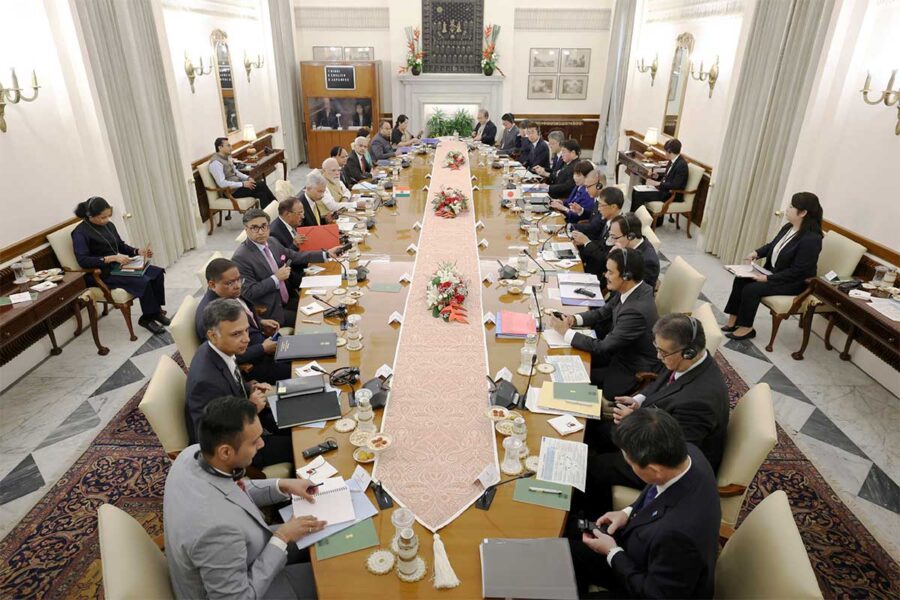
India-Japan Annual Summit Meeting held in New Delhi on July 02, 2026.
Solar and Nuclear Energy Cooperation
Simultaneously, the energy dialogue focused heavily on clean alternatives that bolster national security. While acknowledging the importance of solar PV and nuclear energy, the two governments threw their weight behind pioneering clean ammonia and green hydrogen projects, specifically highlighting a landmark clean ammonia venture in Odisha. These green fuels are viewed not just as tools to combat climate change, but as vital assets to achieve decoupling from fossil-fuel supply chains controlled by volatile regimes.
Freedom of Navigation in Indo-Pacific
The overarching theme of the 16th Annual Summit was a shared strategic outlook for the Indo-Pacific region, bringing together Japan’s updated “Free and Open Indo-Pacific” (FOIP) vision and India’s Indo-Pacific Oceans’ Initiative (IPOI). Both leaders expressed serious concerns regarding the deteriorating situations in the East and South China Seas, explicitly opposing any unilateral attempts to change the status quo by force, coercion, or the militarization of disputed islands.
India-Japan-USA-Australia – Quad Partners
To operationalize their resistance to regional hegemony, Modi and Takaichi reaffirmed their commitment to the Quad framework alongside the United States and Australia. They pledged to accelerate cooperation across the Quad’s core pillars, including maritime security, critical technologies, and humanitarian assistance.
Interestingly, the summit also paved the way for new minilateral architectures. The two leaders announced preparations to launch an inaugural trilateral 1.5 track policy dialogue with the Philippines—a nation currently on the front lines of maritime disputes in the South China Sea. By weaving a tighter web of security partnerships with ASEAN member states, India and Japan are systematically raising the cost of aggression in Asian waters.
Japan Condemns Pahalgam, Delhi Terror Attacks
The leaders also addressed broader global security challenges. They issued a strong, unified condemnation of terrorism, specifically calling out cross-border terrorism originating from Pakistan. The joint statement explicitly referenced recent terror incidents, including the April 2025 attack in Pahalgam, Jammu and Kashmir, and the November 2025 incident in Delhi, demanding that financiers and organizers of these proxies be brought to justice. On global governance, the leaders renewed their push for text-based negotiations to reform the United Nations Security Council (UNSC), mutually endorsing each other’s candidatures for permanent seats in a reformed global body.
No discussion of the India-Japan partnership is complete without its defining symbol of infrastructure: the Mumbai-Ahmedabad High-Speed Rail project. Prime Minister Takaichi reaffirmed Japan’s commitment to assisting India as it aims to commence commercial operations on priority sections of the bullet train network in 2027, including the introduction of advanced E10 trains.
However, the conversation has now expanded far beyond a single railway line. India has unveiled a massive vision for a national High-Speed Rail network spanning 7,000 kilometers, and Prime Minister Modi invited Japanese conglomerates to actively participate in developing these future corridors. By signing a Memorandum of Cooperation on the Next-Generation Mobility Partnership, the two nations are looking to blend Japan’s mastery of advanced mobility, high-speed transit, and shipbuilding with India’s vast market potential and skilled engineering workforce.
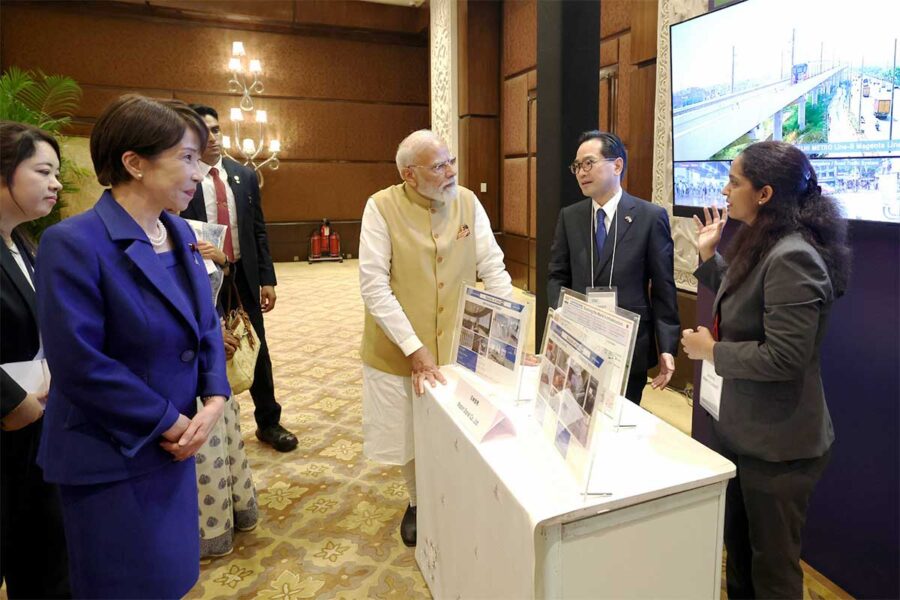
India PM Narendra Modi (R) with Japan PM Sanae Takaichi (L) in New Delhi on July 02, 2026.
Focus on India’s North-East Region
Furthermore, both leaders underscored the strategic importance of India’s North Eastern Region (NER). By building robust road networks, bridges, and industrial value chains connecting India’s northeast with the Bay of Bengal and the broader BIMSTEC region, Tokyo and New Delhi are creating an economic counterweight to China’s Belt and Road Initiative, transforming a landlocked region into a bustling gateway to Southeast Asia.
As Prime Minister Takaichi concluded her landmark visit, accepting an invitation for Prime Minister Modi to visit Tokyo in 2027, the message to the rest of the world was clear. The India-Japan relationship has transcended traditional diplomacy. Bound by shared democratic values, mutual economic vulnerabilities, and a common geopolitical competitor, New Delhi and Tokyo are actively drawing the blueprint for a balanced, multi-polar Asia.
Don’t Miss: US Supreme Court Upholds Birthright Citizenship in a Major Blow to President Trump
Don’t Miss: Sweden Approves Massive Deal to Send Next-Gen Gripen E Fighters to Ukraine