
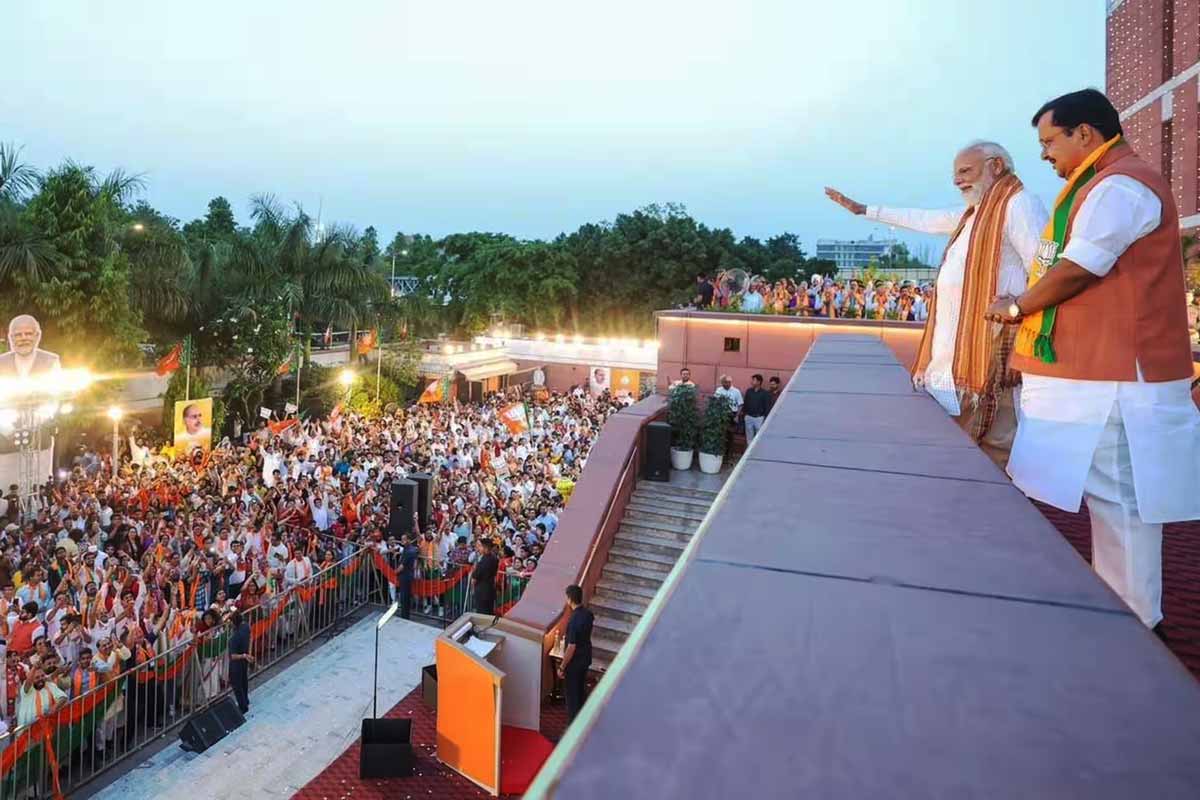


New Delhi: A sweeping wave of political change reshaped India’s electoral map as the Bharatiya Janata Party (BJP) captured West Bengal, actor-turned-politician Joseph Vijay made a stunning electoral debut in Tamil Nadu, and the Indian National Congress-led alliance returned to power in Kerala.
The Assembly election results delivered a clear message of anti-incumbency across regions, with ruling parties in several states facing decisive defeats, while a few strongholds held firm.
BJP’s Historic Breakthrough in Bengal
In a landmark victory, the Bharatiya Janata Party unseated the All India Trinamool Congress government led by Mamata Banerjee, ending its 15-year rule in West Bengal. The scale of the victory was striking, with the BJP breaching traditional strongholds of the TMC, including Kolkata and surrounding districts.
Prime Minister Narendra Modi hailed the result as “historic,” declaring that “a new chapter has begun” and describing the state as “bhay-mukt” (free of fear). He called for a shift from “badla” (retribution) to “badlav” (change), urging an end to political violence.
The victory significantly expands the BJP’s footprint, especially in eastern India, consolidating its dominance across multiple regions.
Assam and Puducherry Hold Ground
While several states witnessed political upheaval, Assam remained an exception, with the BJP securing a third consecutive term with an even larger mandate. The party’s growing strength in the state reflects sustained electoral consolidation.
In Puducherry, the National Democratic Alliance (NDA), comprising the All India NR Congress and the BJP, retained power, reaffirming voter confidence in the ruling coalition.
Vijay’s Political Debut Shakes Tamil Nadu
Tamil Nadu delivered one of the most surprising outcomes, with Joseph Vijay’s party, Tamilaga Vettri Kazhagam (TVK), emerging as a major force in its maiden election.
The party disrupted the decades-long dominance of the Dravida Munnetra Kazhagam (DMK) and the All India Anna Dravida Munnetra Kazhagam (AIADMK), toppling the government led by M. K. Stalin.
Although TVK fell short of a majority in the 234-member Assembly, its performance—crossing the 100-seat mark—has pushed the state toward a potential hung Assembly, opening the door to coalition negotiations.
The scale of the upset was evident as several senior DMK leaders trailed, and Stalin himself lost his constituency, marking a dramatic political shift.
READ: Supreme Court Explains Limits of High Courts’ Powers Under Article 227
Congress-Led UDF Returns in Kerala
In Kerala, voters opted for change by bringing back the Congress-led United Democratic Front (UDF), ending the tenure of the Left Democratic Front (LDF) government led by Pinarayi Vijayan.
The UDF secured a commanding lead, winning or leading in over 100 of the 140 seats, while the LDF’s tally dropped sharply. The result provides a crucial boost to the Indian National Congress, which has faced electoral challenges in recent years.
READ: Indian Troops Depart for India-Uzbekistan Military Exercise Dustlik
A National Message of Change
Across states, the results underscored a strong anti-incumbency sentiment. From West Bengal to Tamil Nadu and Kerala, voters appeared to favour change over continuity, reshaping political equations.
At the national level, the BJP’s continued expansion since 2014 remains significant, with the party increasing its legislative presence across states and strengthening its leadership position.
At the same time, the emergence of new political forces like Tamilaga Vettri Kazhagam signals a shifting political landscape, where regional dynamics and new entrants are redefining traditional power structures.
As coalition talks begin in Tamil Nadu and new governments prepare to take charge across states, the election results mark a pivotal moment in India’s evolving political narrative—one defined by volatility, voter assertiveness, and a clear appetite for change.