
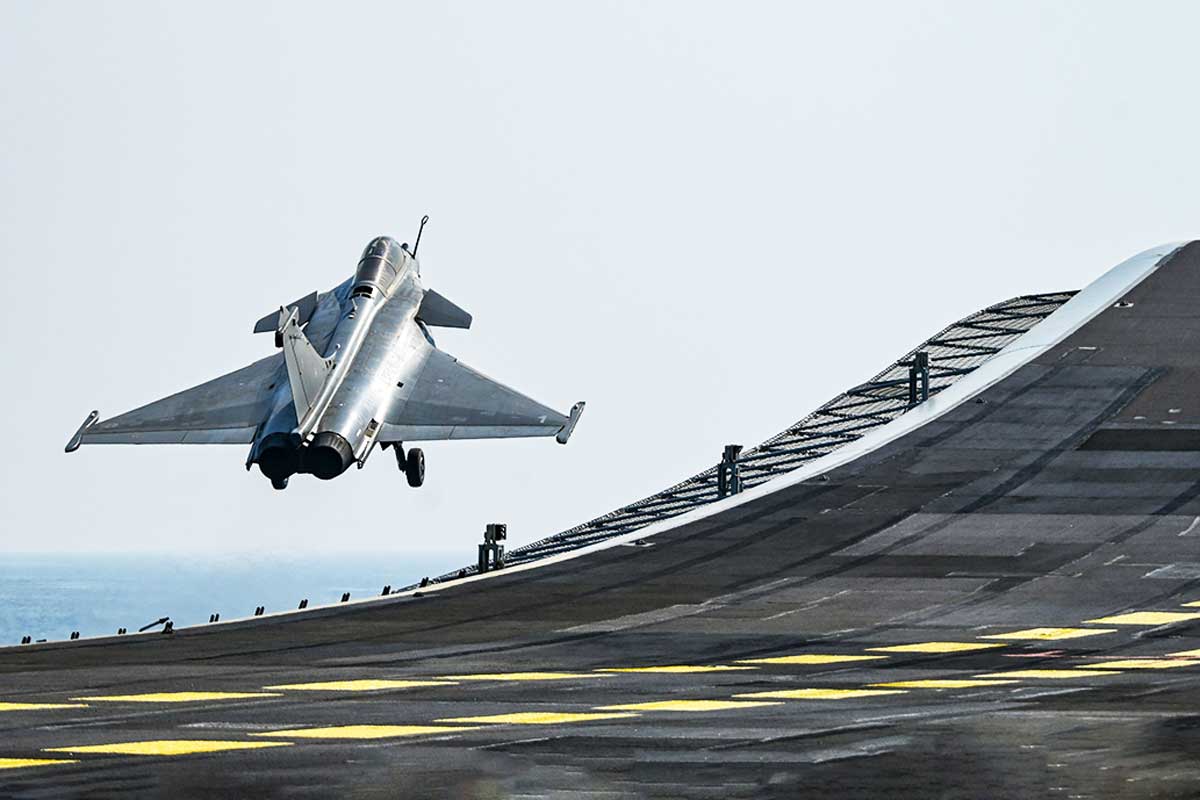

Rafale Marine Landing on INS Vikrant: The successful landing of a French-origin Rafale Marine fighter aircraft on India’s indigenous aircraft carrier INS Vikrant marks an important milestone in the modernisation of the Indian Navy. The aircraft completed its maiden landing on the carrier on 29 October 2026, succeeding on its first attempt during ongoing trials off Goa. The Indian Navy described the achievement as one of the first steps towards operationalising the Rafale Marine in its fleet.
While the landing may appear to be a routine aviation milestone, its significance goes much deeper. It demonstrates progress in integrating an advanced carrier-based fighter with India’s home-built aircraft carrier, strengthens the country’s future naval aviation capabilities and highlights the growing strategic importance of aircraft carrier operations in the Indian Ocean.
The development is particularly important because India is preparing to introduce 26 Rafale Marine fighters into its naval aviation fleet under a defence agreement with France worth approximately Rs 63,000 crore. Their induction will provide the Navy with a modern fighter platform for protecting aircraft carrier groups, securing maritime interests and extending India’s operational reach at sea.
But why is the landing so significant, and what does it mean for India’s maritime ambitions?
A landing that goes beyond symbolism
Landing a fighter aircraft on an aircraft carrier is considerably more complicated than landing it on a conventional runway.
A carrier is a moving platform operating in the open sea. Its flight deck is relatively short, and aircraft must land within a limited space while accounting for the movement of the ship, wind conditions and other operational factors.
Unlike an aircraft landing at an airbase, a carrier-based fighter cannot rely on a long runway to slow down. It uses a specialised tailhook attached to its rear section, which catches one of the arresting wires stretched across the flight deck. This system brings the aircraft to a stop within a short distance.
The Rafale Marine is specifically designed for carrier operations. It has reinforced landing gear and a tailhook to withstand the physical stresses associated with arrested landings.
The successful touchdown on INS Vikrant therefore demonstrates an important stage in establishing compatibility between the aircraft and India’s indigenous carrier.
It is also a significant step in the wider integration process, which involves testing aircraft performance, flight-deck procedures and the modifications necessary for sustained carrier operations.
The challenge: Rafale Marine meets INS Vikrant
One of the most interesting aspects of this development is the difference between the operating systems of the French and Indian aircraft carriers.
The Rafale Marine was originally developed for the French Navy’s nuclear-powered aircraft carrier, Charles de Gaulle. This carrier uses the CATOBAR system, which stands for Catapult Assisted Take-Off But Arrested Recovery.
Under this arrangement, aircraft are launched with the assistance of catapults, which provide the additional acceleration needed to take off from the carrier’s relatively short flight deck.
INS Vikrant, however, operates on a different principle known as STOBAR, or Short Take-Off But Arrested Recovery.
Instead of using catapults, the Indian carrier employs a ski-jump ramp at the front of its flight deck. Aircraft accelerate along the deck before using the upward-curved ramp to launch into the air. For landing, they rely on arresting wires.
This difference makes the integration of Rafale Marine particularly noteworthy. An aircraft originally designed to operate from a catapult-equipped carrier must demonstrate its suitability for a carrier that uses a ski-jump launch arrangement.
The trials are therefore important in establishing how the aircraft can operate within the technical and operational requirements of INS Vikrant.
Earlier, the Rafale Marine had undergone trials at the Shore-Based Test Facility at INS Hansa in Goa. The facility replicates important features of an aircraft carrier’s flight deck, allowing the Navy and aircraft manufacturers to evaluate carrier-related operations before proceeding to shipboard trials.
The successful landing aboard INS Vikrant represents progress from shore-based evaluation to actual carrier integration.
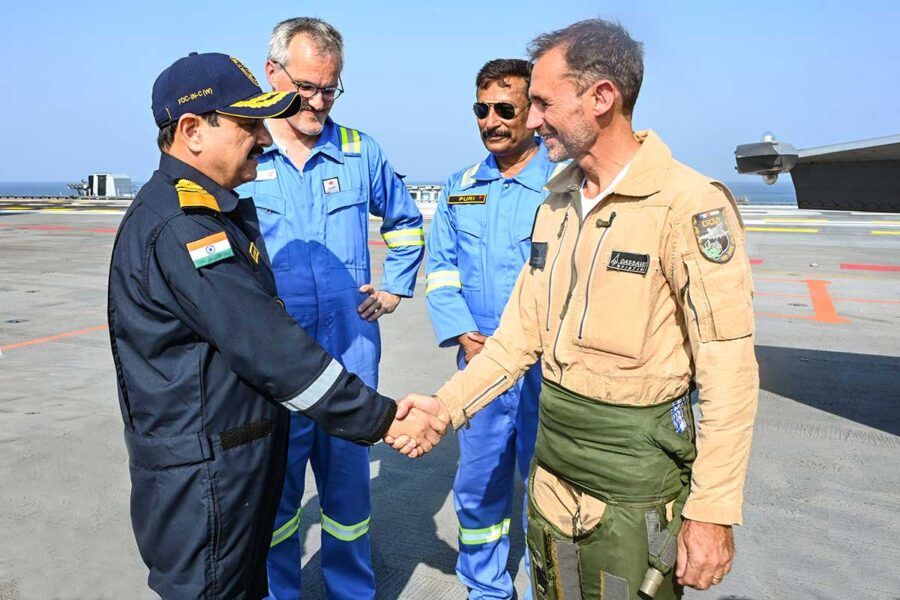
Why Rafale Marine’s Landing on INS Vikrant Matters for India’s Maritime Ambitions.
Why India needs the Rafale Marine
India’s decision to acquire the Rafale Marine is closely linked to the growing importance of naval air power.
Aircraft carriers are not simply floating airfields. They are mobile military platforms that allow a country to deploy fighter aircraft far from its mainland without depending entirely on foreign airbases or land-based infrastructure.
However, an aircraft carrier’s effectiveness depends heavily on the quality and capabilities of the aircraft operating from its deck.
The Indian Navy currently operates MiG-29K fighter aircraft from INS Vikramaditya and INS Vikrant. While these aircraft have provided an important carrier-based combat capability, the Navy needs a modern platform to strengthen its future requirements.
The Rafale Marine is expected to provide capabilities across several important mission areas:
Air defence: Protecting aircraft carriers and accompanying naval vessels against hostile aircraft and airborne threats.
Maritime strike: Providing the ability to engage hostile naval targets and support maritime operations.
Reconnaissance: Gathering information about activities in surrounding maritime areas.
Precision strike: Conducting operations against selected land-based targets when required.
These capabilities will allow the Navy to strengthen the protection of its carrier battle groups and improve its ability to conduct operations across the Indian Ocean Region.
A major boost to India’s aircraft carrier capabilities
India currently operates two aircraft carriers: INS Vikramaditya and INS Vikrant.
INS Vikramaditya, acquired from Russia, has been an important component of India’s carrier-based naval aviation capabilities. INS Vikrant, commissioned in September 2022, represents a major achievement in India’s indigenous warship-building programme.
Built by Cochin Shipyard Limited, INS Vikrant is India’s first indigenously designed and constructed aircraft carrier.
Its introduction has strengthened India’s ability to maintain a carrier presence in the Indian Ocean and surrounding maritime regions.
However, operating two aircraft carriers requires a sufficiently capable fleet of fighter aircraft. The availability of modern carrier-based fighters is essential to ensure that these platforms can fulfil their intended operational roles.
The induction of 26 Rafale Marine aircraft will help address this requirement.
The aircraft are intended to operate from both INS Vikramaditya and INS Vikrant, providing the Navy with a common modern fighter platform across its carrier fleet.
This will also help improve standardisation in training, maintenance and operational planning.
What makes the Rafale Marine a capable fighter?
The Rafale Marine is the naval version of the Rafale fighter developed by French aerospace manufacturer Dassault Aviation.
It belongs to the category of multirole combat aircraft, meaning it can undertake different types of missions rather than being restricted to a single operational role.
The aircraft combines advanced radar systems, electronic warfare capabilities, sophisticated sensors and the ability to carry different categories of weapons.
Its capabilities include beyond-visual-range air combat, maritime strike and precision engagement.
The aircraft’s radar and electronic warfare systems are particularly relevant in modern naval operations, where identifying threats, maintaining situational awareness and coordinating with other military platforms are essential.
Another important feature is its compatibility with India’s existing Rafale fleet operated by the Indian Air Force.
Although the naval and air force variants have important structural differences, they share several systems and technological features. This commonality could help simplify certain aspects of training, maintenance and logistics.
The Indian Navy will also benefit from the experience of the French Navy, which already operates the Rafale Marine from its Charles de Gaulle aircraft carrier.
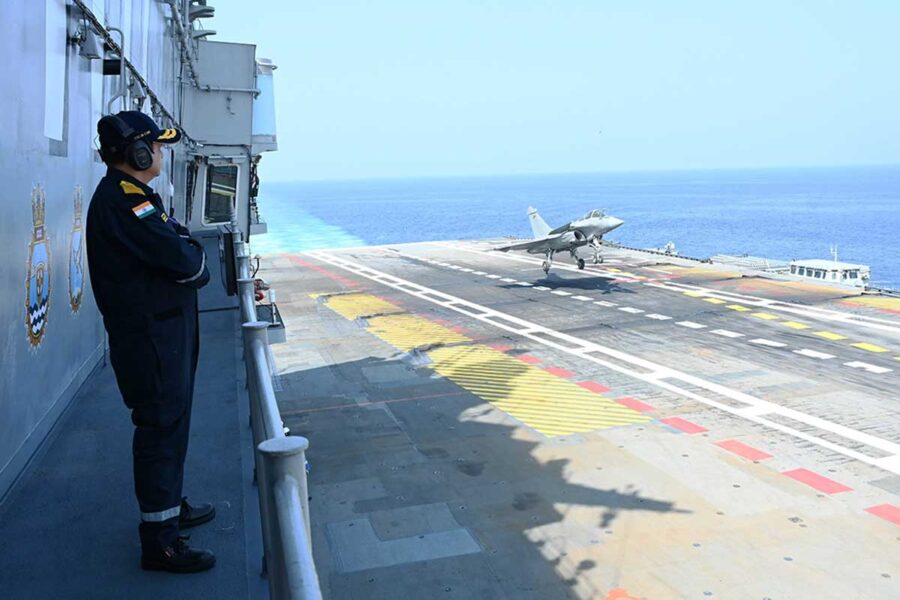
Major Milestone for the Indian Navy.
The strategic importance of the Indian Ocean
The successful landing also needs to be viewed in the context of India’s wider maritime interests.
The Indian Ocean is one of the world’s most important maritime regions. It connects major economic centres in Asia, Africa and Europe and carries significant volumes of international trade and energy supplies.
India’s geographical position gives it a central role in this maritime environment.
The country’s security and economic interests are closely linked to the safety of important sea lanes, freedom of navigation and stability across the wider Indian Ocean Region.
Aircraft carriers provide India with the ability to deploy air power at sea, particularly in areas where land-based aircraft may face geographical or operational limitations.
A modern carrier-based fighter fleet can improve surveillance, provide air defence for naval formations and support maritime operations over extended distances.
The Rafale Marine will therefore contribute to India’s ability to protect its maritime interests and maintain a credible naval presence.
It is also relevant to India’s broader objective of strengthening its position as a security partner in the Indian Ocean Region.
India-France defence partnership gets a new dimension
The Rafale Marine programme is also an important development in India-France defence cooperation.
In April 2025, India and France signed an agreement for the procurement of 26 Rafale Marine aircraft at an estimated cost of approximately Rs 63,000 crore.
The package includes 22 single-seat fighter aircraft and four twin-seat aircraft intended for training purposes.
The agreement covers more than the purchase of aircraft. It also includes training, simulators, weapons, equipment, maintenance and logistical support.
An important element is the provision for technology transfer and the integration of Indian-made weapons into the aircraft.
The agreement also envisages greater industrial cooperation, including manufacturing and maintenance-related activities in India.
This is significant because modern defence procurement increasingly involves developing domestic capabilities rather than relying exclusively on imported equipment.
The programme could create opportunities for Indian companies to participate in the aerospace supply chain, while supporting the development of maintenance, repair and overhaul capabilities.
For France, the agreement further strengthens its defence relationship with India and expands the international presence of its naval fighter aircraft.
The successful landing on INS Vikrant is an important achievement, but it does not mean that the aircraft is immediately ready for full operational deployment with the Indian Navy.
Further trials and integration work will be required to establish operational readiness.
These activities will involve evaluating aircraft and carrier compatibility, validating operational procedures and ensuring that the aircraft can function effectively within the Navy’s carrier aviation environment.
There are also practical considerations involving aircraft storage, maintenance and movement around the carrier’s hangar and flight deck.
The Rafale Marine has relatively wide, non-folding wings, and reports have highlighted the need to address compatibility with INS Vikrant’s aircraft lifts. This illustrates why a successful landing is only one part of the larger integration exercise.
The delivery of the 26 aircraft is expected to begin towards the end of 2028 or in early 2029, with the programme extending towards 2030.
Until then, the Navy’s trials will remain important in preparing the platform for eventual induction.
READ: SCO Meeting: Defence Minister Rajnath Singh Calls for Unified Action Against Terrorism
A milestone in India’s journey towards stronger naval aviation
The first successful landing of Rafale Marine on INS Vikrant represents more than the arrival of a new fighter aircraft on an Indian carrier.
It brings together two important elements of India’s maritime modernisation programme: an indigenous aircraft carrier and an advanced foreign-designed naval fighter.
The development demonstrates progress in India’s ability to integrate sophisticated aviation platforms with its own naval infrastructure.
It also highlights the importance of carrier-based aviation in protecting maritime interests, maintaining regional stability and strengthening India’s operational reach.
The Rafale Marine will not, by itself, determine India’s naval capabilities. Its effectiveness will depend on the availability of trained personnel, supporting aircraft, weapons, maintenance infrastructure and coordination with other naval assets.
Nevertheless, the successful landing is an important step towards building a more capable carrier-based combat force.
As India continues to expand its indigenous shipbuilding and defence manufacturing capabilities, the integration of Rafale Marine with INS Vikrant marks another significant chapter in the country’s evolving maritime ambitions.
The message is clear: India’s aircraft carrier programme is no longer only about building ships. It is increasingly about developing the aircraft, technology, infrastructure and operational capabilities needed to make those ships effective instruments of maritime power.
Don’t Miss: Airubs delivers 32 new satellites to Eutelsat OneWeb Constellation
Also Read: Karnataka High Court Upholds ED Proceedings in JSW Steel Illegal Mining Case