
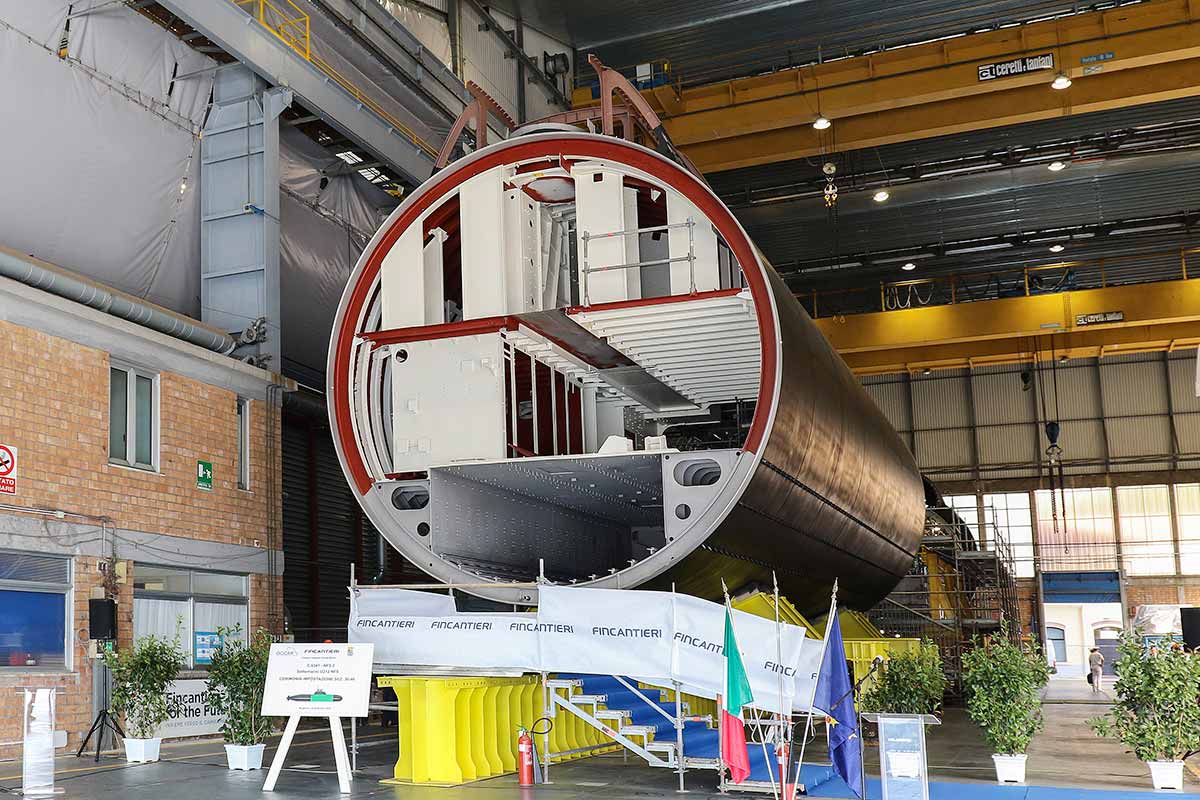


Italy has laid the keel of its second U212NFS submarine, advancing a four-boat programme designed to replace ageing submarines in the Italian Navy and strengthen its ability to operate quietly and for longer periods beneath the sea.
Fincantieri held the keel-laying ceremony for the submarine at its Muggiano shipyard in La Spezia on 1 October. The vessel is scheduled for delivery in 2030.
The milestone comes around eight months after the keel of the first U212NFS was laid at the same shipyard. That submarine is due to be delivered in 2029, meaning Italy is now progressing several boats at different stages of construction.
The programme is based on the German-designed Type 212A submarine but introduces a range of changes developed for the Italian Navy. These include a larger pressure hull, updated combat and platform-control systems, and features intended to improve performance in warmer waters.
At the heart of the new design is a combination of conventional diesel-electric propulsion, lithium-ion batteries and air-independent propulsion. Together, these technologies are intended to allow the submarines to remain submerged for longer while reducing their acoustic and operational signatures.
A larger and more capable U212 design
The U212NFS, or Near Future Submarine, is an evolution of the Type 212A family already used by several European navies.
According to specifications provided by Fincantieri, the Italian submarine is 58.35 metres long and has a pressure-hull diameter of about seven metres. Its displacement is approximately 1,550 tonnes when surfaced and 1,750 tonnes submerged.
Those figures are important because some descriptions of the submarine have put its displacement at around 1,800 tonnes. Fincantieri’s own specifications give the lower figures, providing a clearer reference for the vessel’s dimensions.
The design retains the basic characteristics of a modern conventional submarine while incorporating new Italian-developed systems.
OCCAR, the European organisation responsible for managing the programme, says the U212NFS features an extended pressure hull as well as updated combat and platform-control systems. The design has also been adapted for operations in warmer waters, reflecting Italy’s requirements for naval operations in the Mediterranean and beyond.
Lithium-ion batteries and air-independent propulsion
One of the most important changes is the introduction of lithium-ion battery technology.
Submarines traditionally rely on batteries when operating underwater, with diesel engines used when the vessel is surfaced or has access to atmospheric air through systems such as a snorkel.
Lithium-ion batteries can offer advantages in energy storage and efficiency compared with older battery technologies. For a submarine, that can translate into greater flexibility in how it manages power while submerged.
The U212NFS also incorporates air-independent propulsion, or AIP. The technology allows a conventional submarine to generate energy without continuously relying on atmospheric oxygen.
That is significant because a diesel-electric submarine normally has to periodically surface or use a snorkel to recharge its batteries. AIP can extend the amount of time the submarine remains underwater, reducing the need for such activity.
For a submarine operating in areas where avoiding detection is important, spending more time underwater can provide an operational advantage.
Fincantieri says the combination of the new propulsion and energy systems is intended to improve stealth, endurance and efficiency. The company also highlights improved cyber resilience as part of the new design.
Four submarines are being built
Italy’s programme covers four U212NFS submarines, with construction now progressing across several hulls.
The first submarine had its keel laid on 27 February 2026 and is scheduled for delivery in 2029. The second, now entering the next phase of construction, is due to follow in 2030.
Construction of later boats is also moving ahead. First steel for the fourth submarine was cut in December 2025, showing that the programme is not progressing strictly one vessel at a time.
The schedule was accelerated following a contract amendment signed in July. The €317 million agreement brings forward delivery of the fourth submarine from 2034 to 2032.
Under the revised timetable, the Italian Navy is expected to receive one new U212NFS submarine each year from 2029 through 2032.
The amendment also covers additional equipment, including torpedo countermeasure systems supplied by Fincantieri subsidiary WASS, as well as rescue interfaces and the Navy’s new SAVER system.
Replacing Italy’s ageing submarine fleet
The U212NFS programme is ultimately about replacing Italy’s existing Nazario Sauro-class submarines.
Those boats entered service between the late 1980s and mid-1990s and have formed an important part of Italy’s underwater capability for decades.
Their eventual replacement is becoming increasingly important as the Italian Navy seeks to maintain a modern submarine force capable of operating across a range of missions.
The new submarines are expected to undertake tasks including anti-piracy operations, counter-terrorism missions and patrols aimed at protecting important maritime routes.
They will also have a role in safeguarding energy supply routes and critical offshore infrastructure.
That mission is becoming particularly relevant in Europe, where undersea infrastructure has received greater attention in recent years. Subsea cables and pipelines carry communications, electricity and energy supplies across national borders, making their protection an increasingly important security task.
A modern submarine can provide a discreet platform for monitoring large areas of sea and supporting efforts to protect strategically important infrastructure.
Why the keel-laying matters
A keel-laying ceremony is more than a traditional milestone in shipbuilding. It signals that a vessel has moved into a significant stage of physical construction.
For Italy, the second U212NFS keel demonstrates that the programme is moving beyond its initial phase and towards a steady production rhythm.
The planned delivery schedule is also notable. With the first submarine expected in 2029 and the fourth now scheduled for 2032, the Italian Navy is set to receive the four boats over four consecutive years.
That creates a more predictable path for replacing the ageing Nazario Sauro-class vessels.
The U212NFS programme also highlights the changing technology of conventional submarines. Although the boats remain diesel-electric vessels, newer battery systems, AIP and increasingly sophisticated combat and control systems are changing what such submarines can do.
READ: Karnataka High Court Upholds ED Proceedings in JSW Steel Illegal Mining Case
A new phase for Italy’s undersea capability
The second keel-laying marks another step in Italy’s effort to modernise its submarine fleet.
The U212NFS combines the established Type 212A design with modifications developed for Italian requirements, including a longer hull, new combat systems, lithium-ion batteries and air-independent propulsion.
With four submarines planned and construction already advancing on several hulls, the programme is moving towards a regular delivery cycle.
The first boat is expected in 2029, followed by the second in 2030 and the remaining two by 2032 under the revised schedule.
For the Italian Navy, the arrival of these submarines will gradually replace a fleet whose oldest members date back several decades. The new boats are intended not only to maintain Italy’s underwater presence but also to provide capabilities suited to an increasingly demanding maritime environment, from protecting sea lanes and energy routes to monitoring critical infrastructure beneath the water.
Read: 16th Edition of Aero India Announced for February 2027 in Bengaluru
Read: SICC Rejects Tata Power’s Challenge to Arbitral Award in Kleros Capital Partners’ Case