
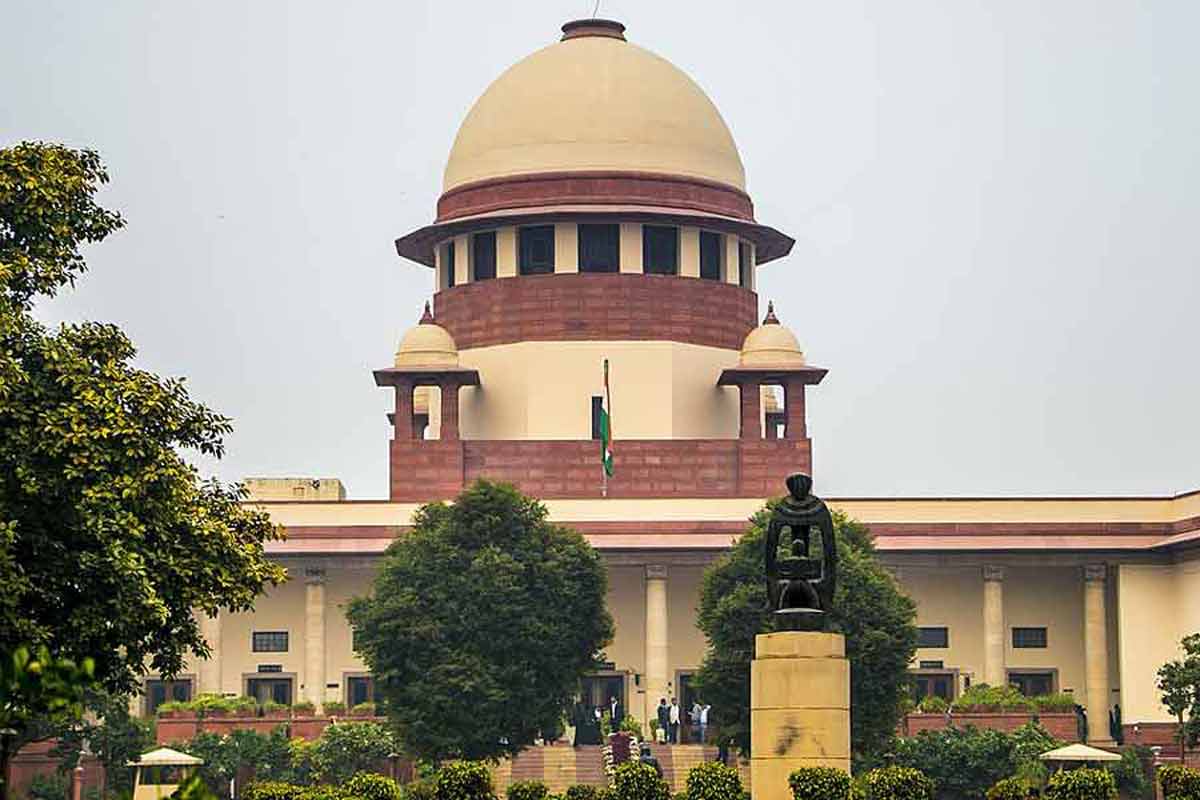


Minimum years of service for getting pension for bank employees?: New Delhi — In a significant ruling clarifying pension eligibility norms, the Supreme Court of India has held that a bank employee who voluntarily abandons service cannot claim pension unless he fulfills the strict requirement of completing at least 20 years of confirmed service, along with other statutory conditions.
The judgment, delivered on April 8, 2026, by a bench of Justice Prashant Kumar Mishra and Justice N. V. Anjaria, draws a firm legal distinction between voluntary retirement and voluntary abandonment, while underscoring that pension is not a discretionary benefit but a rule-based entitlement.
“The present case is not of voluntary retirement, rather of voluntary abandonment of the services,” the Court observed, referring to the employee’s prolonged unauthorized absence.
Background: Unauthorized Absence and Exit from Service
The case concerned a former clerk of the State Bank of India, who joined in 1978 and was confirmed in service in 1979. In 1998, he stopped attending work without applying for leave and travelled abroad.
Despite repeated notices from the bank, he failed to justify his absence. The bank eventually declared in December 1998 that he had voluntarily abandoned service. His later attempt to rejoin in 2004 was rejected, prompting litigation before the Labour Court and the Madras High Court, both of which ruled against him.
READ: Delhi HC Seeks Action Over Rana Ayyub’s Tweets on Hindu Deities, Flags Urgent Need for Probe
Core Issue: Can Abandonment Qualify for Pension?
Before the Supreme Court, the employee argued that he was entitled to pension under provisions applicable to voluntary retirement. The Court, however, rejected this claim outright, holding that abandonment of service—especially after prolonged unauthorized absence—cannot be equated with voluntary retirement.
20-Year Confirmed Service: A Strict Threshold
A central pillar of the judgment is the Court’s emphatic interpretation of pension eligibility under the State Bank of India Employees’ Pension Fund Rules, 1955.
The bench clarified that:
Pensionable service is calculated strictly from the date of confirmation in service—not from the initial date of appointment.
A minimum of 20 years of such confirmed service is a mandatory condition for pension eligibility.
Applying this rule, the Court found that the employee had completed only 19 years, 9 months, and 25 days of confirmed service—falling short of the required threshold.
This shortfall, though marginal, proved fatal.
The Court made it clear that the 20-year requirement is absolute and cannot be relaxed, even by a small margin.
READ: Supreme Court Asks States and UTs to File Affidavits on Prisons’ Condition
No Pension Without Meeting Statutory Conditions
The employee had relied on Rule 22(i)(c), which allows pension after 20 years of service regardless of age if the employee opts for voluntary retirement. However, the Court held that this provision was inapplicable because:
The employee never formally sought voluntary retirement.
His service ended due to abandonment, not a recognized retirement process.
He failed to meet the 20-year confirmed service requirement in any case.
The Court further noted that even under alternative provisions requiring both 20 years of service and a minimum age of 50 years, the employee would remain ineligible, as he had not attained the prescribed age at the time of cessation of service.
No Pre-Existing Right to Pension
The Court also upheld earlier findings that the employee’s claim under Section 33C(2) of the Industrial Disputes Act was not maintainable, as such proceedings require a pre-existing right. Since his pension entitlement itself was disputed, no such right existed.
READ: India–Israel MoU Sets Stage for Expanded Missile Defence, UAV and Cyber Collaboration
Clear Distinction from Earlier Cases
Distinguishing prior judgments cited by the employee, the Supreme Court observed that those cases involved employees who had retired under valid voluntary retirement schemes with undisputed eligibility.
In contrast, the present case involved a foundational failure to meet statutory requirements, particularly the 20-year confirmed service rule.
Final Verdict
Dismissing the appeal, the Supreme Court affirmed the decisions of the Labour Court and the Madras High Court, holding that:
Voluntary abandonment cannot be treated as voluntary retirement.
Pension eligibility depends on strict compliance with statutory rules.
Completion of 20 years of confirmed service is a non-negotiable prerequisite.
Wider Implications
The ruling sends a strong message across the banking and public employment sectors that pension is a statutory right—not an equitable relief—and hinges on precise adherence to eligibility criteria.
By firmly reinforcing the 20-year confirmed service requirement, the Court has removed any ambiguity around marginal shortfalls or attempts to recharacterize unauthorized absence as retirement, ensuring greater clarity and discipline in service jurisprudence.
READ: MoD Signs $278 Million Deal with HAL for Eight Dornier 228 Aircraft